
As we welcome October and the final quarter of 2026, it feels like a good time to reflect on the chapter we just closed. For me, the headline could simply be “Road Trip Summer.” Over a three-month period, I drove through 26% of the United States (yep, that’s 13 states), and a portion of Canada. It was gorgeous, boring, entertaining, fun, and educational.
While the destination, and my “home” for much of the trip was a small, quiet island community in Maine, followed by a week in the mountainous Missouri/Arkansas border, the journey itself became an unexpectedly significant part of the story. In a short period of time, I had the opportunity to interact with people from all over the world while traveling through Michigan, Vermont, Ohio, New Hampshire, Indiana, Missouri, and Ontario (Canada), to name just a few of the places. While I did continue to work during a portion of my travels, I intentionally, mindfully, immersed myself in the experience. This also meant I limited my social media use to less than 60 minutes per day.
The #1 thing I discovered: People are kind, generous with their time, and interested in conversation. With a stranger!
Yes, of course, many of the people I talked to were concerned about the usual headlines – cost of living, AI, global unrest – in terms of “small talk.” However, the more common response to me, a total outsider, was genuine interest and delight in human connection. Curiosity around how a Midwesterner found herself on the rocky shores of a remote island in Maine. Or, as a Missourian, what hiking or biking trails would I recommend to a family in Dogwood Canyon – and should they be worried about skunks or mountain lions?
Not once did I sense any of the vitriol we experience on social media – especially the raw, unfiltered hatred you find in the “comments” sections. There was a true desire for human interaction, and interest in induvial experience, not the filtered, staged photo-perfect version of life. And it certainly didn’t reflect the oppressively toxic sentiment I’d been observing on various online platforms.
It got me thinking about the 90-9-1 Principal (or the 1% Rule). Here are the basics related to social media platforms, online communities, etc.:
- 90% if the users are lurkers who view content and read opinions without ever posting or commenting.
- 9% are passive contributors who interact occasionally via likes, shares.
- 1% are creators and/or superusers who generate the vast majority of original posts, threads, and offer comments.
(Let’s not even attempt to address the overwhelming influence of the “bots” who fall into that 1%!)
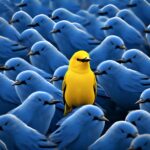
That tiny percentage has created what’s known as “participation inequality and bias.” How? Because a viral political or social “opinion” shared by a top creator online—even one seen by millions—frequently represents the vocal stance of less than 0.1% of the actual human population. Remember, algorithms thrive on engagement, not truth.
This matters. When roughly 53-54% of people across the United States (according to Pew Research Center) and 54% worldwide (Oxford University Digital News Survey) get their news from social media, we must be aware of the difference between objective facts and “personality driven truth.” More than that, though, is what feels like the death of the moderate viewpoint, and a narrative that we are much more toxically divided than perhaps is reality.
This translates to how we navigate our daily lives, how we show up with our families and co-workers, how we lead teams, how we treat the person stocking shelves at the grocery store, or the driver in front of us. Online platforms would have us believe “people are awful” which triggers a defensive mindset, and that carries over to your interactions throughout the day.
When we remember that 99% of the population isn’t posting toxic commentary and opinions, we move into a Kindness Mindset. When we stop projecting the 1% onto the 99% of humans we interact with, we turn off our defensive mechanisms, offer more grace, and are naturally warmer and kinder.
Investing your time and energy into human interaction, where you can see body language and hear the tone of voice, vs. online text/screen interactions, reminds us of what humanity actually looks, feels, and sounds like. That, for me, was the biggest gift of my “road trip summer.”